- An electric field is a vector field that associates to each point in space the force per unit of charge exerted on an infinitesimal test charge at rest at that point
- is the electric field that a charge experiences (in )
- is the force on a charge (in )
- is the test charge (in )
- (vector form: ) or
- SI unit: volt per meter
Electric field due to a point charge
-
- is the point in space where the electric field is being calculated
- is the point charge creating the electric field (in )
- is the distance between the point and the charge (in )
- is the electric field (at ) due to the source charge (in )
- where is the unit vector pointing from to
- is Coulomb’s constant
-
(Superposition Principle) The total electric field at a point in space is the vector sum of the electric fields due to the individual charges
Notes
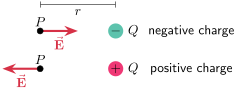
- There is no electric charge at point . But there is an electric field there. The only real charge is .
- Notice that depends only on the charge which produces the electric field, and not on the value of the test charge .
- In the figure, the electric field is positive, so it points towards a negative charge and away from a positive charge. But if the electric field is negative, it is the opposite.
Electric field between two parallel plates
- is the magnitude of the electric field between two parallel plates, oppositely charged
- is the charge on each plate
- is the area of one plate (Gaussian surface)
- Given the plate separation is much smaller than the dimensions of the plates
- This equation is derived from Gauss’s Law and the principle of superposition:
Electric field lines
-
Electric field lines indicate the direction of the electric field; the field points in the direction tangent to the field line at any point (note that the field lines never cross)
-
The lines are drawn such that the magnitude of the electric field, , is proportional to the number of lines crossing unit area perpendicular to the lines. The closer the lines, the stronger the field
-
The lines start on positive charges and end on negative charges
Electrostatic field
- An electrostatics field (or static electric field) is an electric field that does not change with time
- For any electrostatic field:
-
- (uniform electrostatic field)
- is the potential difference between points and (in )
- is the distance between the points (in )
- (uniform electrostatic field)
- for any closed curve
-
Electric flux
- is the electric flux (in ) through a surface in an electric field
- is the electric flux through a flat surface with a vector area in a uniform electric field .
- (See Gauss’s Law for electricity)
Electric displacement field
- electric displacement field (or electric flux density)
-
- is the polarization density
- displacement current density