States
- state of matter (or phase of matter)
Gas
- elemental gases
- monatomic: noble gases
- diatomic:
- Gas laws
- inert gas (גז אינרטי)
Vapor
- vapor (אד, אדים)
- “a substance in the gas phase at a temperature lower than its critical temperature, which means that the vapor can be condensed to a liquid by increasing the pressure on it without reducing the temperature of the vapor” (Wikipedia)
- “gaseous state of any substance that normally exists as a liquid or solid” (Brown, 2012)
- water vapor (or aqueous vapor)
- steam
Phase diagram

(source: commons.wikimedia.org)

- phase diagram
- lines of equilibrium (or phase boundaries)
- The critical point (specifically liquid–vapor critical point) is the point in which the liquid–gas equilibrium curve ends. Beyond this point, the distinction between liquid and gas vanishes, and the substance becomes a supercritical fluid.
- is the critical temperature
- is the critical pressure
- The triple point is the point in which all three phases coexist in dynamic equilibrium
- standard temperature and pressure (STP)
- until 1982:
- since 1982:
- threshold temperatures for a substance at a given pressure:
- melting point (or liquefaction point) (נקודת התכה, נקודת היתוך)
- freezing point (or crystallization point) (נקודת קיפאון)
- boiling point (נקודת רתיחה)
- “the temperature at which the vapor pressure of a liquid equals the pressure surrounding the liquid and the liquid changes into a vapor” (Wikipedia)
- the temperture such that
- stronger intermolecular forces require more energy (higher temperature) to overcome, resulting in higher boiling points
- normal boiling point (or atmospheric boiling point)
- standard boiling point
- “the temperature at which the vapor pressure of a liquid equals the pressure surrounding the liquid and the liquid changes into a vapor” (Wikipedia)
Example: water

(source: commons.wikimedia.org)

Phase transition
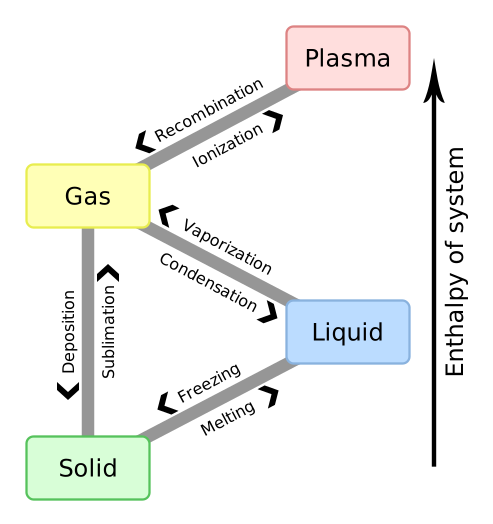
(source: commons.wikimedia.org)

- phase transition (or phase change) (מעבר פאזה)
- melting (התכה, היתוך, (
המסה)) - condensation (התעבות)
- vaporization
- evaporation (התאיידות, התאדות, אידוי)
- boiling (or ebullition) (הרתחה)
- sublimation (המראה, סובלימציה)
- freezing (הקפאה, התמצקות)
- melting (התכה, היתוך, (
- see latent heat
- determining state of matter at room temperature:
- ionic compound → usually solid
- network solid → almost always solid
- alloy or pure metal → usually solid (exception: Hg is liquid)
- molecular compound:
- bigger/heavy molecule → higher boiling point
- higher polarity → higher boiling point
- capable of hydrogen bonding → higher boiling point
- volatility (נדיפות)
- weak IMFs → high volatility (evaporates easily) → low boiling point
- strong IMFs → low volatility (evaporates slowly) → high boiling point
- higher vapor pressure ↔ higher volatility
References
- Brown, Theodore L. (2012). Chemistry. Prentice Hall.